Saturday, January 24, 2015

Perspectives on Mount Lemmon climbing


Rising over the horizon east of Tucson, Arizona are the Santa Catalina Mountains, of which Mount Lemmon is the tallest. We had heard about climbing at Mount Lemmon (we later discovered that all the climbing in the Catalinas is collectively referred to as “Mount Lemmon”), and wanted to check it out. As our time in southern AZ was limited we decided that the best way to approach Mount Lemmon this time around was to do so as a scouting mission. We wanted to see and explore and learn as MUCH as possible about the area over a two day period, in order to decide if it would be worth it for us to go back. So here is our short-term evaluation of the climbing and the area – it has helped us and hopefully it will shed some light for a few others as well!

Overview
The Catalina Highway winds its way up to the top of Mount Lemmon over the course of 45-60 minutes, with plenty of climbing from mile 0 to the summit. The scenery is beyond stunning, with ecosystems shifting from the proud Saguaro Cacti of the Sonoran desert, through thick conifer forests, and into alpine areas. Beautiful orange and yellow rock is found in canyon after canyon, and many of the walls are decorated with green and black lichens. In our opinion, Mount Lemmon was worth the visit simply for the view.

View over the canyon from Windy Ridge
The Catalina Highway
Mount Lemmon is part of a National Forest, meaning you pay a fee to be there, but fortunately it is almost negligible. Five dollars a day or twenty dollars for a year pass, and during the off-season there are segments of the highway that don’t require any fee at all. There is also camping on the mountain (no amenities except pit toilets) and while some sites cost a small fee, other sites are free!  In the winter, at least Molino Basin Campground and Gordon Hirabayashi (Prison Camp) are open.

At the base of the mountain there are plenty of grocery stores to choose from. Directly on Catalina Highway is a Safeway, and next door you can find a small coffee shop called Le Buzz - a well-known climber hotspot with great food and coffee. Still on the east side of town but about 15-20 minutes from the bottom of the highway are a Trader Joes and a Sprouts, which offer some healthier/organic grocery options. Alternatively, if you’re already on the mountain and don’t wish to drive down, there is a small town called Summerhaven at the very top, where you can find a great restaurant called the Cookie Cabin that serves up delicious pizza and cookies. Unfortunately we can’t speak to where a good place to fill water might be, but we've contacted the visitor centre with hopes of hearing back.

From what we can tell, Mount Lemmon is suitable as a year round climbing destination, however dry spells of Spring and Fall may be best. In the summer, average temperatures in the high 20s (degrees Celsius) could restrict climbing to shady and/or high elevation crags. In our case, we were unable to reach the highly praised climbing at The Fortress due to snow, and on the lower mountain streams were high enough such that the landing zones around boulders were under water. Mid-mountain however, the January temperatures between 10 and 20 degrees Celsius made for great conditions. We would have still been more than busy over a couple weeks if we had the time. 

View from the top of Mount Lemmon
Road to The Fortress closed due to snow
Morning light hits the stream in which the Molino Basin Boulders sit
 
Route Climbing
Day one at Mount Lemmon was overcast and somewhat stormy with a few sprinklings of light rain. We spent this day visiting two of the crags at Windy Point West. The first crag was called North Fin, and boasts classics ranging in difficultly from 5.7 (trad) to 5.13c (sport). The crag is easily accessed, located in a beautiful corridor beyond which the canyon is visible. We climbed a couple mid tens here which were quite fun, and eyed up some other routes. When we return Graham is hoping to get on Tree Monsters (5.12d  3 stars) and Genevieve (5.13c 3 stars).
Kim raps off in the corridor at North Fin crag
In the afternoon we headed to Beaver Wall, a crag only five minutes away. This wall is tall and beautiful – a brilliant orange colour with large black streaks, and slightly overhanging with crimps and impressive linear features. Unlike North Fin crag, the Beaver Wall has much higher exposure with the openness of the canyon behind you. This wall has one of the hardest routes at Mount Lemmon, Hebe (5.14-  4 stars). Graham redpointed Right Tissue (5.12c), a technical but endurancy and sustained “warm-up” on the wall.

Graham climbs Right Tissue (5.12c) at Beaver Wall
The weather on our second day was spectacular, with clear blue skies, much lower humidity, and temperatures approaching 20 degrees. We climbed this afternoon at The Helmet crag in the Windy Ridge area. The Helmet includes a vertical wall and a small cave with four unique lines and a couple of fun extensions. Graham snagged the onsight of The Crossing (5.12b  3 stars) and Dwarf Toss (5.12c  3 stars). We would have given the rock a great rating if it weren’t for the glue-reinforced holds – but regardless of this the movement on steep terrain was very fun.

Looking out from the cave at The Helmet
Graham onsights The Crossing (5.12b) in The Helmet cave

There are several other classic routes that Graham is excited to get on when we return, including Heel-A Monster (5.13- 4 stars) at the Orifice, Poplar Mechanics (5.12+ 3 stars) at Beaver Wall and Free Loader (5.13- 4 stars) at the Helmet, to name a few.


Bouldering
The bouldering is fairly limited and leaves something to be desired. To be fair though, our judgment is limited to what we observed, as we didn’t actually DO any bouldering while there. There are two main areas to boulder...

At the lower highway, a few difficult problems at Hairpin Boulders are scattered in the wash.
 
Checking out the holds on Block Obama (V10)
Glue-reinforced holds on Block Obama (V10)
A little higher up the highway, the Molino Basin Boulders rise out of a creek bed. The setting is very beautiful and in the wintertime, we discovered the boulders literally sit in the water of the stream, making winter bouldering a no go. The rock is super smooth and river polished – akin to the glacier polish segments of “Incredible Journey” at Forgotten Wall in Squamish – with beautiful crystals and patterning throughout.

Checking out some problems on the Boxcar Boulder in Molino Basin
Smooth, smooth river polished holds 
 
***
 
Because we didn't stay up at Mount Lemmon, we did not have a chance to experience the climbing culture in the area. We didn't see a single other person climbing either, although this is likely because we were there mid-week in the middle of January, it had recently rained, and the number of crags in the area is expansive. There are two indoor gyms in Tucson, which we’ve heard are very popular and a great way to meet local climbers. We’re planning to spend 2-3 weeks at Mount Lemmon next winter and are stoked to get to know the community.

The area guidebook, “Squeezing The Lemmon II” came out in 2000, and is available at gear stores in town. Due to our brief stay we did not purchase the guidebook, but rather found the info we needed on the Mountain Project App. We were quite impressed with the app, however some routes (trad lines especially) were difficult to find. We plan to invest in the book when we return next year!

Saturday, January 17, 2015

Destination #2: Joshua Tree


Joshua Tree. Desert oasis. Dry heat. Freezing temperatures. Crumbling granite mounds. Rattlesnakes. Land of never-ending rock and funky-gnarled J Trees…straight out of Dr. Seuss.

This place was beautiful to explore, climb, hike, rest, or simply exist in. There is nothing quite like desert sunsets and sun rises, moon rises and stars, snow storms versus midday heat, and land that seems to extend forever.


The climbing in Joshua Tree was….unique. Think Squamish (kind of) that meets blistering sun, blasting sand storms, and old weathered rock that seems to crumble away under your fingertips. We were at first both negative and cynical about the rock quality, and while a subtle love-hate relationship still persists, the desert eventually won us over. We learned that an almost defensive protectiveness of the rock quality was often the prevailing sentiment of J Tree lovers. For example, the guidebook is littered with statements like the following: 

"Cleaning established problems should be done with extreme discretion, as climbing sometimes loose rock may be part of the problem's character"

or,

"Unfortunately, holds continues to crumble and the problem may well not be climbable"  (from a THREE out of four star problem...)

One thing we learned quickly was that a trip to Joshua Tree is not a trip where you try to push your grades. Even seeking out the “best quality” problems in the guidebook is not necessarily the best strategy – rather we found that walking the areas to find the problems that LOOK the coolest regardless of how hard or how “starred” they were, was the best way to find things we were psyched on.

Over our three and a half weeks here, we've concluded that the overall style of Joshua Tree is super techy on sloping or very sharp holds. For the most part Kim couldn’t climb while we were here due to her finger injury – but on the bright side the friction-y slab and slopers did allow her to do some bouldering without stressing the pulley too much...

 
When we first arrived in the town of Joshua Tree we stopped at one of the local gear stores, Nomad Ventures, to ask about camping. We had heard that camping in the park was $10-$15 a night and difficult to come across, so we were wondering if there were any cheaper options. The staff at the store were great and directed us to “The Pit”, a low-key free camping spot outside the park (ask at Nomad’s and they’ll show you the way!). Shortly after arriving we were greeted enthusiastically by a French couple with Arizona licence plates…lo and behold they were from Quebec! Lennie and Sam were down exploring the area over their winter break, and we had a great time climbing with them over the next several days. When they left they even lent us their guidebook to use for the remainder of our stay! Thanks guys :D

 
On our first day out we went to an area called “The Outback”, which is near Hidden Valley Campground and has a high concentration of high quality problems. After getting thrashed on the warm-ups we checked out a very technical problem called Relic (V9) which involved a few burly moves to a technical traverse with very small hands and feet. This problem looked to suit my style so I figured I’d give it a shot to start collecting some projects for this leg of the trip. To my surprise I was able to send fourth try. Woo! Off to a great start! The rest of the day we spent wandering the area and checking out other cool-looking problems like Thin Lizzy (V8) and Tidal Wave (10).

 
Christmas came next and we were lucky to be able to spend it with my parents who are also traveling down south on a bird-watching trip. Over three luxurious days with them we stayed in a lovely hotel (daily showers!!), and spent the days hiking, birding, and eating Thai food. They even watched us boulder one day – the first time they’ve ever seen us climb outdoors.


A few days after Christmas our Aussie friends, Ali and Jordan, arrived in J Tree and we met up with them again! The four of us struggled through a few days of bouldering as we continued to wrestle the rock and the increasingly cold temperatures that eventually led to snow on New Years Eve. While the fluffy white stuff did hinder our ability to climb, nothing stands in the way of Joshua Tree’s desert beauty.


Fortunately, the temperatures warmed up and we were back in the blissful desert sun before too long. I eventually started to click with the style and began to send problems that I had my eye on earlier in the trip. After a couple days of projecting I was able to top out Tidal Wave (V10). I was kind of surprised to send this as I usually hate everything to do with arêtes, and the crux moves felt impossible on the first day I tried it. Needless to say, my psych was high when I rolled over the top!

I was happy to tick one other 10 while in J Tree, a climb with NO arêtes, which was super fun and a bit more my style. The Love Machine (V10) is a link up where you climb the very steep slots of Ryan Roof Problem (V5), bust a very big move into a very tensiony move, and then join the top of Gospel According To Niles (V5) to the left. It took a few attempts to figure out the link up moves but I was super stoked to be able to send it second go from the start.  

After Kim, Ali, Jordan and I had been together for about a week, we met Ted and John from “the yoga retreat”. We spent our final week in J Tree as a group of six hanging out at as many different boulders as we could get our hands on (literally). These guys were rad and we had an awesome time! Turned out John shoots photos for a living and had been the photographer at the aforementioned yoga retreat (check out his webpage here). He showed Kim several tricks-of-the-trade, and even let her use some of his fancy equipment. It was pretty crazy to see the difference that using a flash gives in the results…

Graham goes for the big move on Thin Lizzy (V8) - NO FLASH
Graham goes for the big move on Thin Lizzy (V8) - FLASH
Ali squeezes her way up the arete of Scatterbrain (V6) - NO FLASH
Ali squeezes her way up the arete of Scatterbrain (V6) - FLASH
Joshua Tree is mainly known for its route climbing, not its bouldering. With this in mind, we did dabble in a bit of route climbing amidst our bouldering days. It was very fun and would have been nice to do more – something for future trips!

Cryptic (5.8). Photo credit: Ali Roush
We were sad to leave Joshua Tree, but super happy that we did go in the end. We weren’t sure how we’d like it due to mixed reviews we’d heard before arriving. All in all, it is a beautiful place to spend a lot of time, and while the bouldering wouldn’t necessarily make our “top destination list”, we had a really great time. J Tree has made the cut of places that we are stoked to go back to!

Arizona bound now. Off on our next great adventure!

Monday, January 12, 2015

Bouldering in Bishop - VIDEO

We finally finished putting together a video of some of our Bishop bouldering highlights. This was the first stop on our North American rock climbing tour...


~ Kim and Graham

Tuesday, January 6, 2015

Desert Bird Oasis

Time flies. Happy New Year! We have now been in Joshua Tree for two weeks. We hung out and climbed with some lovely people (Lennie and Sam) from Montreal, spent a wonderful Christmas with Graham’s parents, and just before New Years became reunited with our Aussie friends from Bishop, Jordan and Ali. 

J Tree family Christmas

I have been completely thrilled with Joshua Tree from a desert ecology perspective. While I believe this would have been the case regardless, I am fairly certain it is aided along by my inability to climb. I have spent a lot of days doing cold-weather-puffy-marshmallow-desert-yoga and finger putty exercises…


Meanwhile, Graham has been getting into the J Tree groove, and climbing some very awesome-looking problems.

False Hueco Traverse (V2)
The Love Machine (V10)
Attempting "the move" on Nicole Overhang (V10)

But what I really want to talk about in this post are the new desert bird species we have seen. These are mostly common winter birds down here, but to me each new species has spiked an I-can-hardly-handle-it level of excitement. Even as I get to know and recognize the birds the thrill doesn't dissipated. Graham has captured most of the bird photos we have (and even admits that he likes it!) Kudos to him, as these guys RARELY sit still. 

Acorn Woodpecker
Black-tailed Gnatcatcher
Black-throated Sparrow
Cactus Wren
Greater Roadrunner
Say's Phoebe
Ladder-backed Woodpecker
Oak Titmouse
Verdin

The other thing I am quite excited about are the cacti. So many kinds! And they are all out to get us, each in their unique, spiny beauty. Here are a few of the common suspects we tend to come across.

Beaver Tail Cactus
Barrel Cactus
Jumping Cholla
Hedgehog Cactus

Finally, in the visitor centre the other day I saw the “Field Guide to Desert Holes”… my intrigue was piqued at the idea that one could write an entire field guide on holes in the desert floor, so I flipped through it a bit. MY am I ever tempted…. We shall see if I can resist. In the meantime, here are a couple creatures who use those desert holes. 


A rattlesnake! In January! Photo credit: Ali Roush
All for now. More updates on more climbing-related things coming soon :)


Saturday, December 20, 2014

Bye bye Bishop

The end of December is nearing and it is time again to hit the road. We have loved every moment of the experience in our first destination, and are definitely psyched to return.

Our route to Bishop, California

***
First, a quick update on our van home. The Millenium FalcVan has been great for us, and we have all the room we need. It's a wee bit cluttered at the moment, but here are its primary features....

The shelf that holds many of our random bits. Books on hand, first aid kits, muscle/tip/dry skin equipments, etc etc. Yoga mats for essential stretching times.


Our kitchen area! Many more essential things (food!) are stored in these cupboards. The counter is just the right size for prepping cold meals late at night, or storing delicious 35 cent loaves of bread from Erick Schat's bakery...


The front area, behind the curtains. This tends to be the hardest to keep organized, mostly because of the constant turnover of hiking shoes/flip flops/climbing shoes/camp slippers, and the (many) very inexpensive cases of beer... Our plug-in cooler, which has been working GREAT as powered off our solar panel, fits perfectly between the seats.


The bed has turned out to be plenty big enough and nice and cozy. We have a thermometer in the van, and so far mornings have been between about 3 and 6 degrees when we wake up - so the hardest part about the bed seems to be getting out of it!


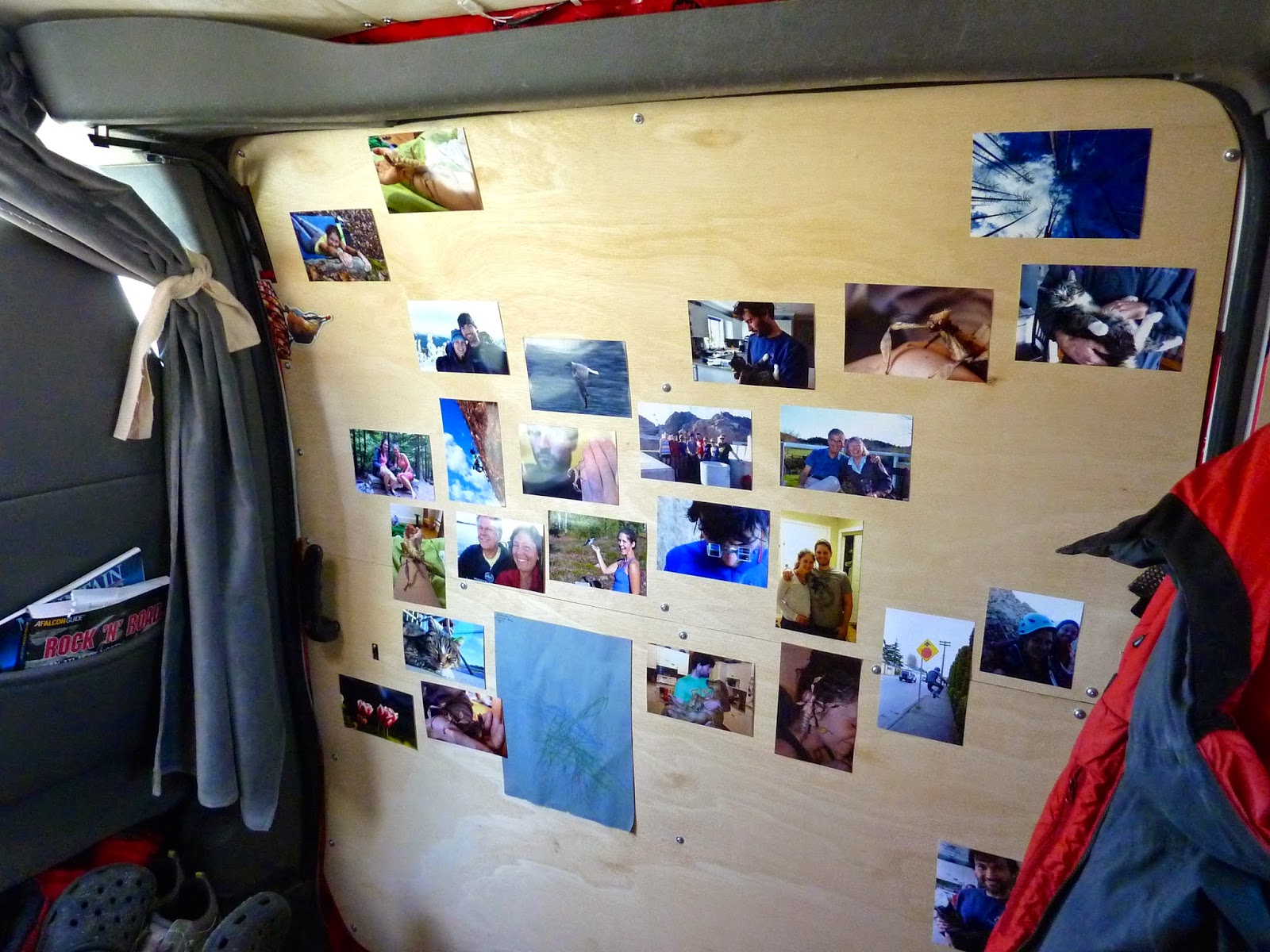
Finally, we have started a memory wall on our sliding door. So far we have put up some photos from home, but we're planning to keep adding as the trip goes on.


***
The bouldering in Bishop has been outstanding, but one of the coolest things has been the chance to climb with so many great friends. In a culmination of vans and climbing psych, we spent nearly three wonderful weeks with Julie, Dan, Mika and Tristan, and also had the pleasure of connecting with the lovely Aussie's, Ali and Jordan. We had the joy and pleasure of meeting Sam and Steph (check out their roadtrip and blog here), Josh, and Matt as well many other lovely human beings. Great bouldering, great Shanghai Rummy, great Sleepytime tea. I don't think I managed any true group shots, but a number of moments do capture some of the good times...


There are several areas to boulder in Bishop, and we focused most of our attention on three of them: The Happy Boulders, the Sad Boulders, and the Buttermilks. The Happies and the Sads are small canyons packed to the brim with volcanic tuff boulders. Pockets, crimps, jugs - steep overhangs and technical slabs - basically lots of fun movement and sequencing potential. The Milks are well spaced, impressively huge monzonite boulders. Skin robbers, but lots of fun.

Graham and I tried to climb as much as we could in these three areas. We wrapped up with G topping 190 problems (VB to V11), and me finishing 88 (VB to V5). Our time in Bishop is the longest period completely dedicated to bouldering that Graham and I have now experienced....and our bodies are feeling it. As much as we didn't anticipate saying this, we are looking forward to the few days of rest before we make it to our next destination. Raw and bleeding tips, aching wrists/tendons/joints, sore muscles to the point of feeling bruised all over, and plenty of surface scrapes and bruises to top it all off. Yet - this is all part of the game, part of the joy of working projects and making progress and experiencing new lines. This is what we love.


A few of the problems we climbed were memorable enough to occupy our day dreams and night dreams, and keep us focused and ambitious. These were projects that shut us down, kept us trying, kept us fighting. Heartbreaks (some of them which are STILL heartbreaks), and those that ended in celebration. Here were some of our favourites:

Acid Wash (V10).
First V10 of the trip. This was one of two problems Graham had his sights set on before heading out to Bishop. Over the course of two days he worked out the moves, with the last move giving him the most trouble. After countless attempts going to the last hold, Julie suggested, "why don't you grab the good part?" So smart... following her great advice, Graham sent first go next day!

Sucker Punch (V5).
I spent four days over the course of nearly three weeks working this climb. The line is beautiful, powerful, short, crimpy, and fun. Each day ended with a little bit of progress, hence the desire to continue. Unfortunately it is also a climb that demands a lot of skin, and with a tough right-hand full crimp at the crux, it is rough on the tendons as well. After a session on the fourth day of working it, I left it for another day. A few hours later though, we walked past and I decided to have one. more. go. A send!


Morning Dove White (V7).
A beautiful problem on the rim, visible from much of the canyon. The problem moves from pockets to crimps with core intensive changes in body position along the way, and a spookily high top out that keeps the heart going at the finish. This problem frustrated Graham beyond belief. He made it to the hold just before the horizontal break on his first go, but despite days of trying, was unable to latch the good holds that lead to the top. Eventually, Graham switched the beta for the last move and topped out second go with the new beta! Hurrah!

Molly (V5). 
Definitely my favourite problem so far in Bishop. A hard, beautiful line that climbs with big yet technical moves on small holds, up a tall and slightly overhanging face – with the business up high. Super proud of this climb, it was super fun every time I was on it, and one that I felt provided measurable success each day.


Beefcake (V10) / Beefy Gecko (V11).
Beefcake was the other climb (along with Acid Wash) that Graham had his sights set on in Bishop. This was until he went and actually tried it one afternoon following a long day of climbing.... moves that felt way too hard for him to do. After those few tries he had essentially given up on the problem, but the niggling ambition eventually encouraged him to return to try again. We went one afternoon (where we met Sam and Josh!) and he was able to figure out the crux moves in isolation. We went back the next day and after a few attempts Graham topped the problem out! On Dan's recommendation, he decided to try Beefy Gecko, a problem that does the crux moves of Beefcake then proceeds right to do one more hard move before a jug finish. A send next day marked his first V11!! Wooooo!

Fly Boy Arete (V5).
The problem that did my finger in... So pleased to have walked away with a send on this one, even though I would trade no send for no injury in a heartbeat. I had a great time working this problem with friends  - it was hard for me the whole way through, a climb that demanded almost more than I thought I had to give out. To top it all off, the top out felt like the most desperate struggle of any of my projects so far. Fun, powerful, and thrutchy - I'd recommend it!
Photo by Tristan Ploughman


We are off to Joshua Tree now for Christmas, but much of Bishop remains on our radar… we’ll be back.